
What is Attenuation valie?
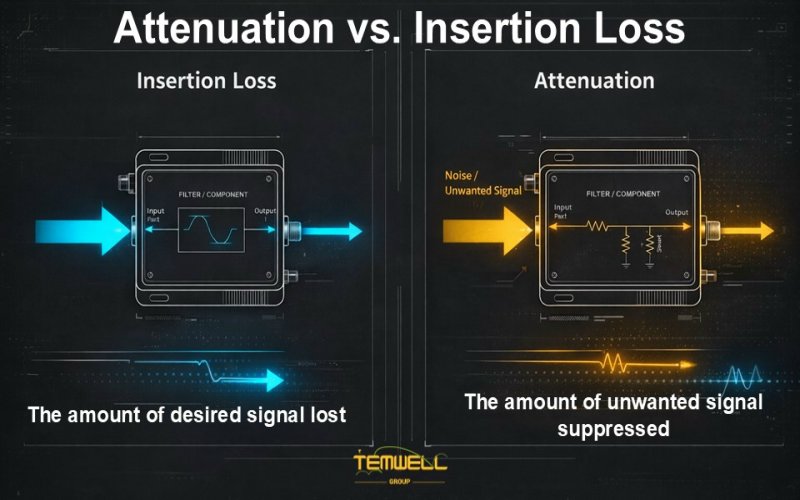
In RF and Microwave systems, Attenuation value is one of the most important fundamental parameters for engineers when selecting RF filters. Whether in wireless communication, satellite reception, IoT, or laboratory measurements, Attenuation value directly affects the system's interference immunity and signal stability. In simply way, Attenuation value of a FF filter refers to how much unwanted signal the RF filter can block.
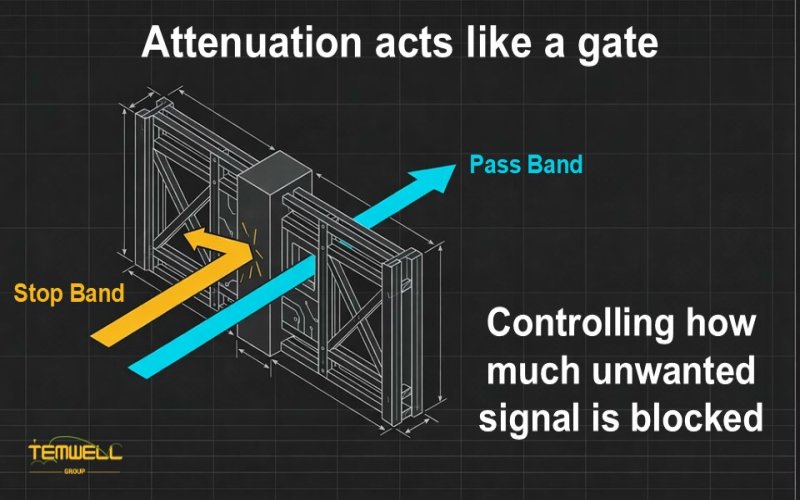
Attenuation value of RF filter refers to the degree to which a signal is "attenuated" or "suppressed" after passing through the RF filter, usually expressed in dB (decibels). It describes the proportion of power or voltage reduction of a certain frequency component between the input and output terminals and is one of the important indicators for evaluating RF filter performance.
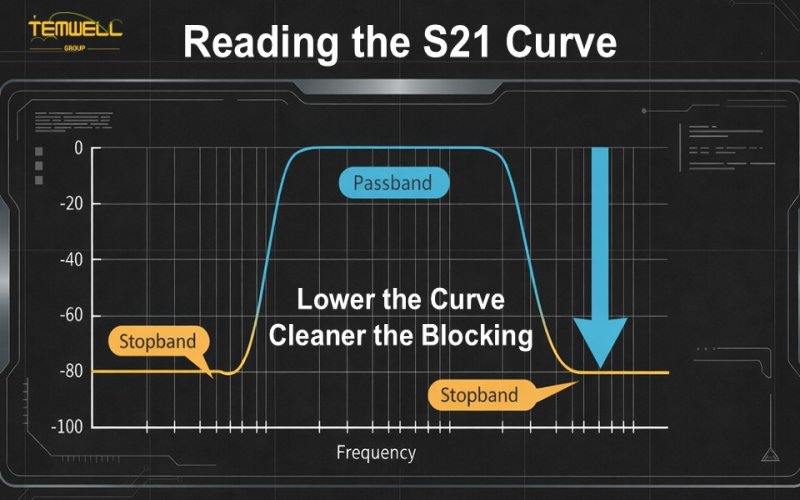
In frequency response curves, RF filters are divided into "passband" and "stopband". Within the passband, lower Attenuation value is desirable, meaning the signal is almost unaffected; for example, Insertion loss might be only 1-3 dB. In the stopband, higher Attenuation value is preferred, such as 30 dB, 50 dB, or even higher, indicating effective suppression of unwanted noise or interference. Higher Attenuation value indicates stronger suppression capability. In wireless communications, radar, base stations, or IoT devices, high stopband attenuation helps prevent adjacent channel interference and noise from affecting system stability.

How to determine whether it is a good value?
Attenuation value of RF filter not only represents the degree of signal attenuation but also directly reflects the strength of its "rejection capability." For customers, the key is often not the entire frequency curve, but whether a clear suppression target can be achieved at a specific interference frequency. For example, a rejection effect of 40 dB or 50 dB or more must be achieved at a certain adjacent frequency to ensure that the system is not affected by external signal interference. If the rejection at that frequency is insufficient, even if the passband performance is good, the overall system may still experience problems such as false triggering, decreased sensitivity, or increased noise.
However, achieving high rejection at a specified frequency is not easy. When the interference frequency is close to the passband, the filter requires a steeper cutoff slope and a higher-order design structure, which increases design difficulty and cost, while also placing higher demands on dimensional and process tolerances. In addition, temperature drift and material errors can also affect the actual rejection amount, making mass production stability a major challenge.
More importantly, there is often a trade-off between insertion loss (IL) and rejection. When a design emphasizes higher stopband rejection, the resonant order or coupling strength is usually increased, which may lead to an increase in passband loss. Conversely, if IL is excessively reduced, making the passband flatter, the stopband rejection capability may decrease. Therefore, RF filter design must strike a balance between IL and rejection, optimizing the curve shape according to the actual application requirements, rather than simply pursuing the extreme performance of a certain value.
the common form of Attenuation value
Attenuation value of RF filter refers to the degree of energy reduction of a signal after passing through the filter, measured in dB. Different types of RF filters, due to their different functions, exhibit different characteristics and focuses in their Attenuation value.
Band Pass Filter (BPF) maintains low Attenuation value (low Insertion loss) within a specific frequency band (Passband), while rapidly increasing Attenuation value at the ends of the passband to form stopbands. Its Attenuation value performance typically focuses on two key aspects: the minimum Insertion loss (IL) within the passband (e.g., ≤2 dB), and the rejection required at specific frequencies in the upper and lower stopbands (e.g., ≥40 dB at 2.4GHz). The curve shows a low-to-high shape.
Low-pass Filter (LPF), on the other hand, maintains low Attenuation value below the cutoff frequency, and Attenuation value gradually increases with frequency above the cutoff point. The key lies in the location of the cutoff frequency and the Attenuation slope (roll-off). Advanced designs can achieve higher dB rejection over shorter frequency ranges.
High-pass filter (HPF) exhibit the opposite performance to Low-pass filters (LPFs). They show high Attenuation value in the low-frequency range, but the Attenuation slope rapidly decreases to a stable low-loss region above the cutoff frequency. The key focus is again on cutoff accuracy and slope performance.
Band-stop filter (BSF), on the other hand, create a deep Attenuation valley (notch) within a specific frequency range. Their Attenuation value is often expressed as "Notch Depth," for example, achieving 50 dB suppression at a certain interference frequency(Center Frequency) while maintaining low Attenuation value in other frequency bands.
Industrial radar is often used for storage status monitoring, distance or speed detection. The working environment may contain a lot of electromagnetic interference, so the selectivity and suppression capability of the RF filter are required to avoid external noise affecting the measurement results.
Therefore, the attenuation curves of different filter types have different shapes. During design evaluation, it is necessary to observe whether the attenuation distribution meets the system requirements according to the application objectives.
How to find the value from the performance curve?
Attenuation value of RF filter defines the degree to which a signal is suppressed at different frequencies. Different types of RF filters define their Attenuation values slightly differently.
The attenuation value of a BPF (bandpass filter) is determined starting from the "passband boundary" of the curve. Generally, the maximum Insertion loss within the passband is used as a benchmark. When the frequency exceeds the upper or lower passband limits, the curve begins to extend significantly downwards, entering the stopband. The corresponding dB value at this point is the attenuation value. Engineers typically identify the cutoff position at the passband edge frequency (e.g., -1/-3 dB) and read the corresponding suppression level (e.g., -40 dB) at a specified frequency point outside the passband (e.g., ±X MHz from the center frequency) as the basis for rejection determination.
The attenuation value of an LPF (low-pass filter) is defined by its low loss below the cutoff frequency and its suppression capability at certain specified frequencies above the cutoff frequency.
High-pass filters (HPFs), on the other hand, maintain low attenuation at high frequencies while requiring a certain level of suppression at a specified low-frequency point.
Band-stop filters (BSFs), however, define the attenuation depth within a specific interference band, for example, requiring 50 dB suppression at the center interference frequency.
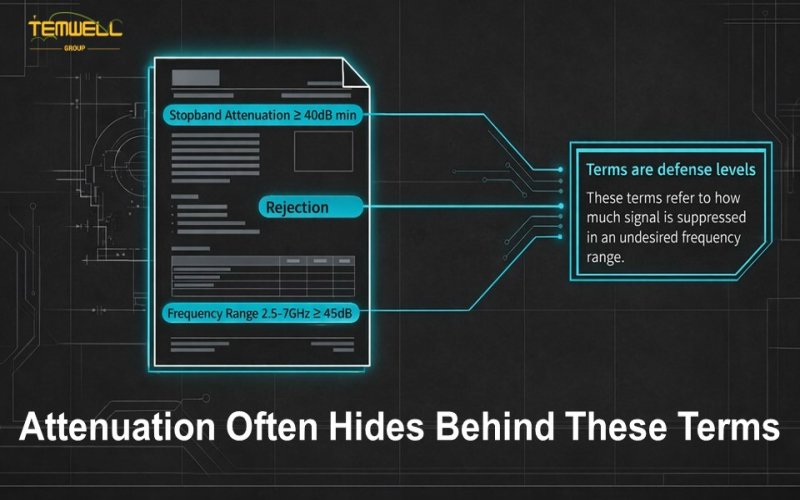
In practical applications, engineers typically judge performance based on "specified frequency bands or specific frequency points." Therefore, specifications often specify "Attenuation value at a certain frequency," such as Rejection ≥ 45 dB @ 1.9 GHz, as a clear performance benchmark.
Experience Sharing
In practical design, Attenuation value of RF filter is not simply a matter of pursuing the highest possible value, but rather a balance achieved under overall engineering conditions. While higher rejection indicates stronger suppression capability, it often comes at the cost of increased structural complexity and design difficulty.
When specifications require high dB suppression near the passband, it is usually necessary to increase the filter order, add resonant units, or adopt a structure with a higher Q value. This directly affects component size and mechanical configuration, while increasing material and manufacturing costs. For space-constrained or cost-sensitive applications, excessively high attenuation values may be impractical.
Furthermore, temperature stability and process tolerances are also critical factors. Changes in material properties with temperature can cause frequency drift, shifting the originally designed suppression frequency; dimensional errors in manufacturing can also lead to differences between mass-produced products and the design curve. High-Q structures are particularly sensitive to tolerances, and their actual attenuation value performance is easily affected.
Therefore, when developing attenuation specifications, performance requirements, size limitations, cost control, and mass production stability must be comprehensively considered, and the most reasonable and feasible design solution should be obtained through overall optimization.
Temwell Service and Support
Temwell specializes in providing customized design and manufacturing services for high-performance filters. Based on customer system requirements, it can precisely plan the attenuation value and overall frequency response curves. Whether applied to communication equipment, industrial control, radar, or IoT systems, Temwell can tailor-make corresponding insertion loss and rejection specifications according to specified center frequency, bandwidth, and specific interference frequencies, ensuring the expected suppression effect at critical frequency locations.
In terms of filter products, Temwell can design customized bandpass filters based on system frequency band, bandwidth requirements, and suppression targets, covering various application conditions from low to high frequencies and from narrow to wide frequencies. Our engineering team can optimize key specifications such as Insertion loss, Selectivity, Group delay, and temperature stability, so that the RF filter can better meet the actual system requirements, rather than just conforming to the datasheet values.
In terms of product types, Temwell offers BPF, LPF, HPF, BSF, as well as various duplexers and special structure filter solutions, and can optimize size and structure according to space constraints and power requirements. For applications with high suppression requirements, the team can improve stopband attenuation value performance while controlling passband loss by adjusting the order, coupling design, and high-Q structures.
In addition, Temwell also emphasizes temperature stability and mass production consistency. Through rigorous design simulation, sample verification and process management, it reduces the impact of tolerances and environmental factors on the attenuation curve, ensuring that the product can maintain a stable and reliable attenuation value under actual use conditions.
If you are interested in Temwell support and Service, feel free to contact us and get free consultation services so that we can provide you with the best solution.
Subscribe to us on Facebook for the latest product news.