
What is V.S.W.R ?
VSWR (Voltage Standing Wave Ratio) of RF filter is an important indicator for measuring the impedance matching degree in an radio frequency (RF) system. When a signal is transmitted from the source to the filter, if the filter's input or output impedance is not perfectly matched to the system's standard impedance (typically 50Ω), a reflected wave will be generated. The superposition of the incident and reflected waves creates a standing wave phenomenon on the transmission line, and VSWR is a value describing the severity of this phenomenon.
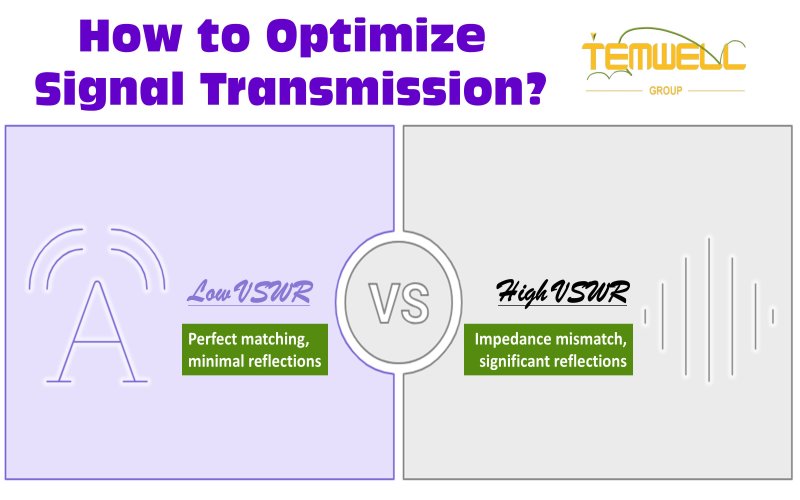
In filter applications, a low VSWR is typically required within the passband to ensure efficient signal transmission and reduce power loss. Excessively high VSWR can lead to decreased power amplifier efficiency, and even cause component overheating or system instability. Therefore, VSWR is one of the important parameters for evaluating filter matching quality and overall RF performance.
What's the good value for VSWR ?
VSWR (Voltage Standing Wave Ratio) of RF filter is an important indicator for evaluating impedance matching. In actual measurement, engineers typically use network analyzer (VNA) to measure the reflection parameters S11 (or S22). The instrument sends the incident signal into the filter port and simultaneously measures the reflected energy, then converts the reflection coefficient into a VSWR value. Therefore, VSWR is essentially a matching indicator derived from the amount of reflection.
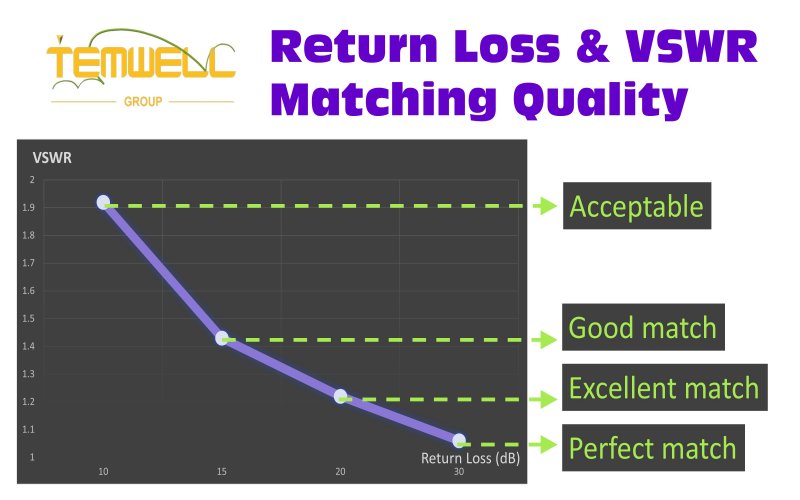
When judging the quality of the value, the ideal situation is 1:1, representing perfect matching with no reflection. Generally, 1.2 to 1.3 is considered very good; below 1.5 is acceptable in most communication applications; 2.0 indicates significant reflection; and above 3.0 indicates poor matching, which may affect power transmission and system stability.
In practice, engineers will check whether the VSWR is below the specified value within the designated operating frequency band to ensure that the filter has good matching performance in actual applications.
Relationship Between VSWR and Return Loss
VSWR (Voltage Standing Wave Ratio) of RF filter is an indicator used to describe the degree of impedance matching at the ports, while Return Loss is a parameter expressed in dB to represent the amount of reflected energy. Both essentially stem from the same physical phenomenon—signal reflection caused by impedance mismatch—just expressed in different ways.
You can think of them as two different "expressions":
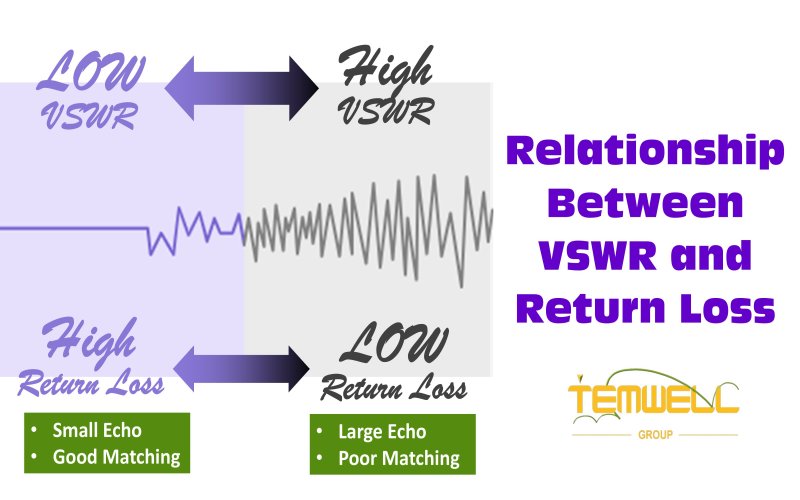
• Return Loss uses "decibels (dB)" to represent the strength of reflection loss. The higher the number, the less reflection.
• VSWR uses a "ratio" to represent the degree of matching. The closer the ratio is to 1:1, the better the match.
When an RF signal enters a filter, if the impedance does not match the system's standard value (typically 50Ω), reflected waves will be generated. The reflection ratio can be expressed using the "reflection coefficient," and both VSWR and Return Loss are derived from the reflection coefficient. VSWR is presented as a ratio, such as 1.2:1 or 1.5:1; Return Loss is expressed in dB, such as 20 dB or 15 dB. There is a fixed mathematical relationship between the two: the closer VSWR is to 1, the smaller the reflection, and the larger the Return Loss value in dB.
This is like describing a conversation—Return Loss is saying "how small the inaudible echo is," while VSWR is saying "what the ratio of the echo to the original sound is." Regardless of the method used, the goal is to determine how much energy in the system is wasted on reflections.
For example, VSWR of 1.22 corresponds to a return loss of approximately 20 dB, indicating good matching; a VSWR of 1.5 corresponds to a return loss of approximately 14 dB; and a VSWR of 2.0 corresponds to a return loss of approximately 9.5 dB, indicating a significant increase in reflection. Therefore, in practical applications, low VSWR and high return loss are desirable for optimal matching quality. Engineers typically measure the S11 parameter and simultaneously observe the VSWR and return loss curves to comprehensively evaluate the port matching performance of the filter.
When developing and evaluating product designs, Temwell Group engineering team usually considers both of these data points and presents them in the datasheet, allowing customers to understand the product's matching quality and reflection characteristics in a familiar way.
Affect factors for VSWR
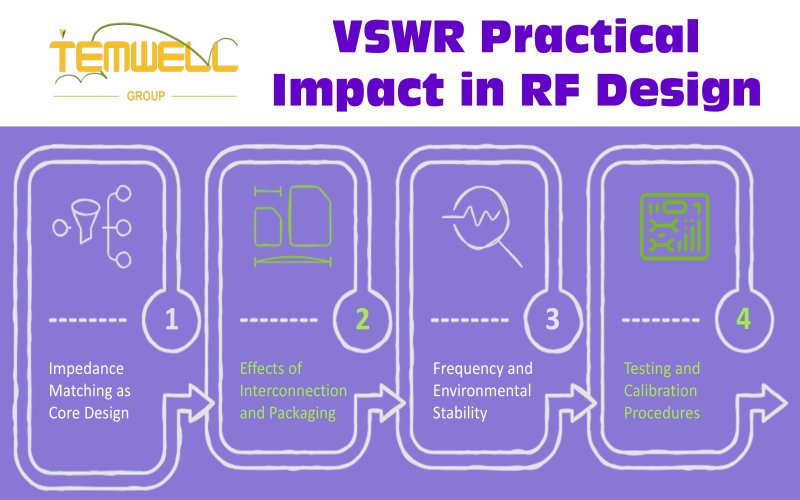
In RF design, VSWR (Voltage Standing Wave Ratio) of RF filter is a core indicator for evaluating impedance matching quality. Its practical impact can be understood from the following four aspects:
1. Core Design of Impedance Matching
The essence of VSWR lies in whether the impedance matches the system's standard value (e.g., 50Ω). During the design phase, precise coupling structures, line widths, and equivalent circuit configurations are necessary to ensure good matching within the operating frequency band. Inadequate matching design will lead to increased reflections, affecting power transmission efficiency and overall frequency response.
2. Connection and Packaging Impacts
Even with a well-designed filter body, after actually assembled, VSWR can still change due to soldering quality, connector structure, PCB routing, or packaging. Poor grounding, improper via design, or structural tolerances can introduce additional discontinuities, causing increased reflections.
3. Frequency and Environmental Stability
The dielectric constant of materials and structural dimensions change with temperature, thus affecting the impedance matching position. If the design does not allow for temperature drift tolerance, the VSWR curve may shift under different environmental conditions, affecting the stability of practical applications.
4. Testing and Calibration Process
VSWR measurements are typically performed using a VNA and require a complete calibration procedure (such as SOLT calibration) to eliminate errors in the test cables and fixtures. A rigorous testing process is crucial for ensuring data accuracy and design verification.
Therefore, VSWR is not merely a measured value, but a comprehensive reflection of the overall quality of design, manufacturing, and verification.

VSWR requirements from different applications
(a). 5G and Mobile Communication Modules: ≤1.2 VSWR Value
High-frequency, high-power applications require extremely low reflection to ensure stable gain.
(b).Radar and Avionics: ≤1.3 VSWR Value
Reduce standing wave error to avoid detection signal distortion.
(c).Industrial Automation and IoT Devices: ≤1.5 VSWR Value
Maintain stable communication while balancing cost and performance.
(d).Medical and Measurement Equipment: ≤1.1 VSWR Value
High-sensitivity systems require extremely high impedance matching accuracy.
Temwell Group provides customized matching adjustments and simulation recommendations based on different market needs to help customers quickly achieve their optimal VSWR targets.
Temwell Group—complete assurance from design to measurement
Temwell Group possesses comprehensive capabilities in RF design, simulation, manufacturing, and measurement, ensuring that every RF filter (Cavity Filter, Helical Filter, DR/Ceramic Filter, SAW Filter ) and Microwave Components (Duplexer/Diplexer, Combiner/Splitter, Multiplexerc, Coupler, Isolator, Circulator, Amplifier) exhibits low VSWR and high stability in practical applications.
With over 30 years of experience in RF filter and microwave component R&D, through precise simulation and rigorous process control, we ensure that every RF filter maintains low VSWR and excellent matching characteristics. Adhering to the professional spirit of "Made in Taiwan × Global Quality," we are committed to helping customers build high-performance, low-reflection, stable, and reliable RF systems, realizing a more powerful and stable future of wireless connectivity.
If you are interested in Temwell support and Service, feel free to contact us and get free consultation services so that we can provide you with the best solution.
Subscribe to us on Facebook for the latest product news.