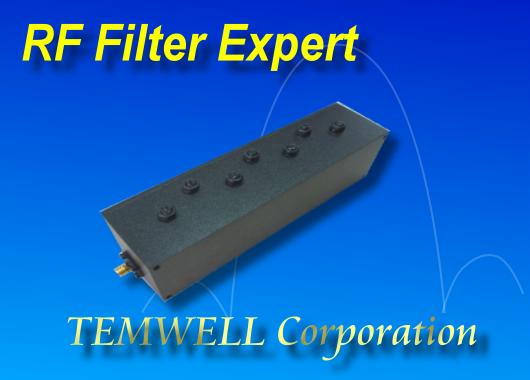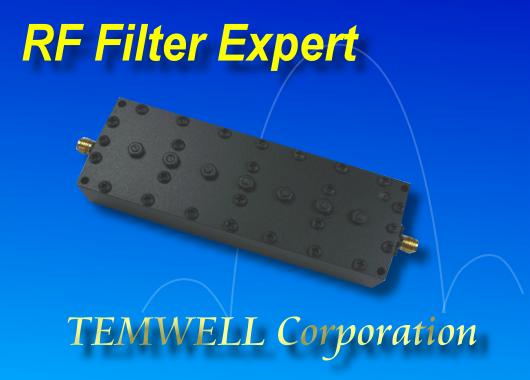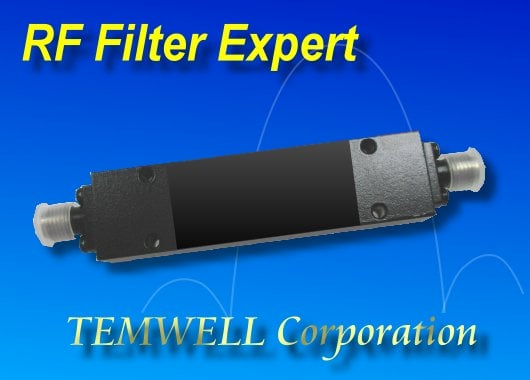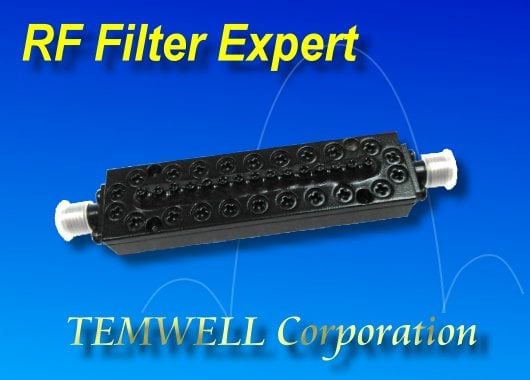

What relationship between RF filter and railroad system?
RF filters play a crucial role in railroad systems, directly impacting communication stability and operational safety. Firstly, in terms of frequency selection, RF filters accurately transmit signals across specific frequency bands, ensuring that different systems such as train control, dispatching, and passenger services operate independently without interference. Secondly, in terms of interference rejection, they effectively block interference from adjacent frequency bands or external wireless signals, improving overall communication reliability. Furthermore, RF filters help improve signal integrity, reducing noise and distortion, maintaining clear and stable transmission over long distances. In multi-channel equipment, their system isolation function prevents transmitted and received signals from interfering with each other, ensuring normal equipment operation. Simultaneously, RF filters also protect critical components, preventing excessively high-power signals from damaging sensitive receivers. In summary, RF filters are an indispensable core component supporting the stable, safe, and efficient operation of railway wireless communications.
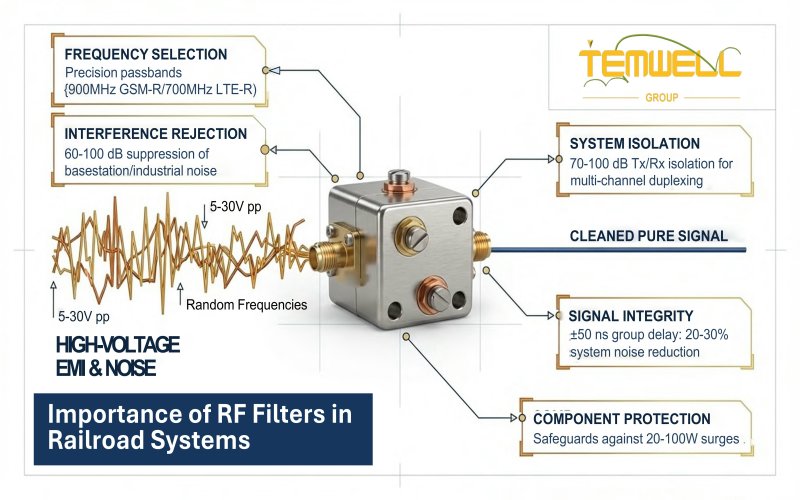
(1) Frequency Selection
The RF filter can accurately pass through a specified frequency band (such as 900 MHz GSM-R or 700 MHz LTE-R) and maintain an insertion loss of less than 1.0 dB within the passband, ensuring effective signal transmission. Simultaneously, it can provide 40–80 dB of suppression capability for non-target frequency bands, avoiding spectrum overlap and interference between different communication systems, improving spectrum utilization efficiency and system stability.
(2) Interference Rejection:
In railway environments, RF filters provide a high rejection rate of 60–100 dB against adjacent channel and out-of-band interference, effectively blocking the effects of base stations, wireless equipment, or industrial noise. Even in environments with high electromagnetic interference, they can maintain the clarity and stability of communication signals, ensuring that train control and dispatching signals are not interfered with.
(3) Improved Signal Integrity
RF filters can reduce system noise by approximately 20–30% and control group delay variation within ±50 ns, reducing signal distortion. For long-distance (several kilometers or more) or high-speed (over 300 km/h) scenarios, they help maintain stable signal quality and data accuracy, improving overall communication performance.
(4) System Isolation
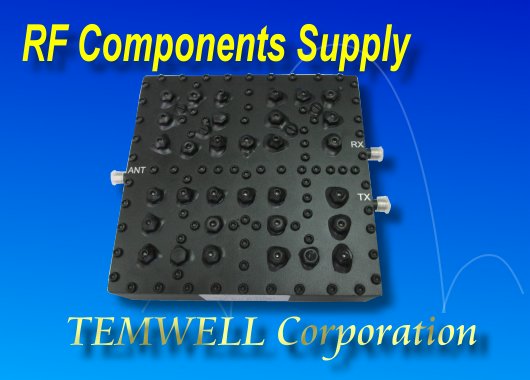
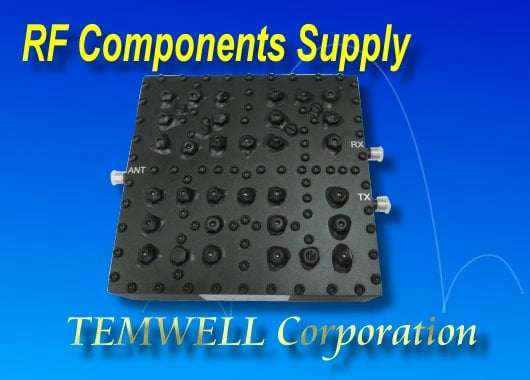
In duplex or multiplex systems, RF filters can provide 70–100 dB of isolation, effectively preventing high-power signals from the transmitter (Tx) from interfering with the receiver (Rx). This feature is particularly critical in base stations and vehicle-mounted equipment, ensuring stability and efficiency even when multiple channels are operating simultaneously.
(5) Component Protection
RF filters can withstand input power of 20–100 W and effectively suppress surges or abnormal signals, preventing high-energy signals from entering sensitive receiving components. Through stable power handling and filtering effects, they not only enhance system safety but also extend equipment lifespan and reduce maintenance and replacement costs.
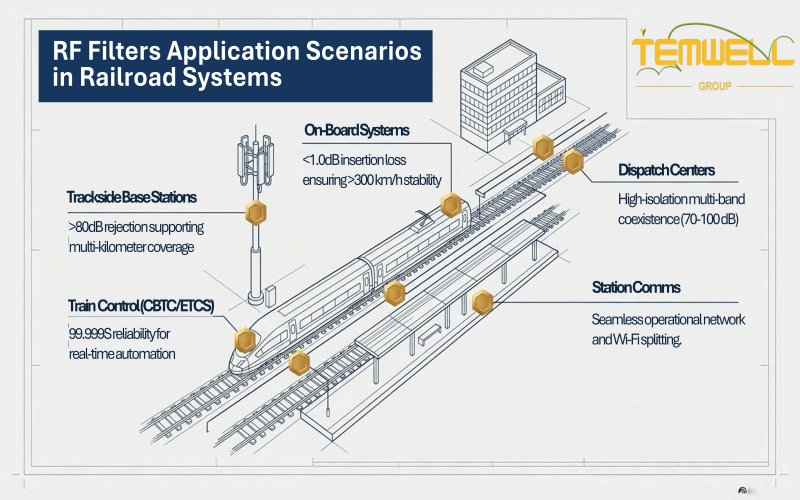
Application Scenarios of RF Filters in Railway Systems
In railway communication systems, RF filters are widely used in various critical scenarios to ensure stable signal transmission and safe system operation. From train operation to ground infrastructure, all aspects rely on efficient filtering technology to reduce interference and improve communication quality. The following describes the main application scenarios.
(1) On-board Communication System
RF Filters are used in the wireless communication modules on trains, supporting GSM-R (approximately 900 MHz) or LTE-R (approximately 700 MHz) frequency bands. They must have low insertion loss (
(2) Trackside Base Stations
In a base station system, RF filters are used for transmitting and receiving signal filtering and frequency band separation to improve receiving sensitivity and signal purity. They typically require high suppression (>80 dB) and good isolation performance to support stable communication coverage over a range of several kilometers.
(3) Train Control System (CBTC / ETCS)
In critical control systems, RF filters ensure the accuracy and timeliness of control signal transmission, supporting high reliability (99.999%) requirements. By effectively suppressing interference, they prevent signal misinterpretation or delay, ensuring safe train operation.
(4) Dispatch and Command Center
RF filters are used in multi-band communication equipment to help different systems operate simultaneously without interfering with each other. Through a high isolation design (70–100 dB), dispatch efficiency and system integration capabilities can be improved.
(5) Station Wireless Communication System
In the station environment, RF filters support the coexistence of passenger services (such as Wi-Fi and emergency communications) and operational systems. Their high selectivity and stability ensure good signal quality and service experience even under multi-system operation.
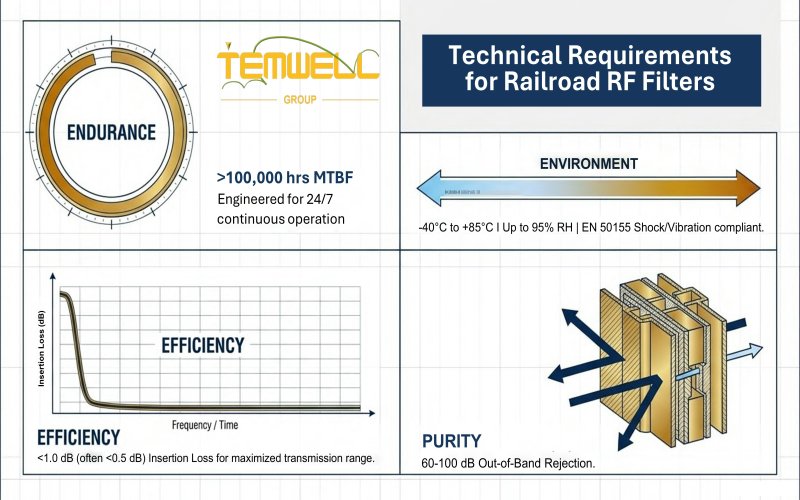
Technical requirements for RF filters in railway applications
In railway communication systems, RF filters not only affect signal quality but also directly impact the overall system stability and train operation safety. Facing long-term operation and harsh environmental conditions, filters must possess high reliability, excellent electrical performance, and good environmental adaptability. The key technical requirements are explained below.
(1) High Reliability and Long-Term Stable Operation
Railway systems are high-safety-critical applications, and RF filters must possess extremely high reliability, typically requiring an MTBF (Mean Time Between Failures) of tens of thousands to hundreds of thousands of hours or more. The equipment must support 24/7 continuous operation and maintain stable performance over many years of use to avoid communication interruptions or system risks due to component failure.
(2) Vibration Resistance and Environmental Tolerance (Temperature, Humidity)
RF Filters must meet harsh environmental conditions, including an operating temperature range of -40°C to +85°C and the ability to withstand high humidity (up to 95% RH). They must also comply with railway standards (such as EN 50155) and possess good vibration and shock resistance to cope with the continuous vibrations during train operation and harsh outdoor environments.
(3) Low Insertion Loss
To ensure effective signal transmission, RF filters must have low insertion loss in the passband, typically less than 1.0 dB, and even below 0.5 dB. Low-loss design reduces power waste, improves communication distance and system efficiency, and is particularly important for long-distance railway communications.
(4) High Rejection
RF filters must effectively suppress adjacent channel and out-of-band interference, typically requiring a rejection ratio of 60–100 dB. High rejection helps block external noise and unnecessary signals, ensuring the purity of critical communication frequency bands, thereby improving the overall system stability and security.
(5) Compact Size and Module Integration
apability In automotive equipment and base station applications, space is usually limited, so RF filters need to have miniaturization capabilities while supporting modular integration (such as combining with duplexers and multiplexers). Through high-density design, multifunctional integration can be achieved in a limited space, improving system design flexibility and efficiency.
Design Challenges, Customization Needs, and Failure Assessment Requirements
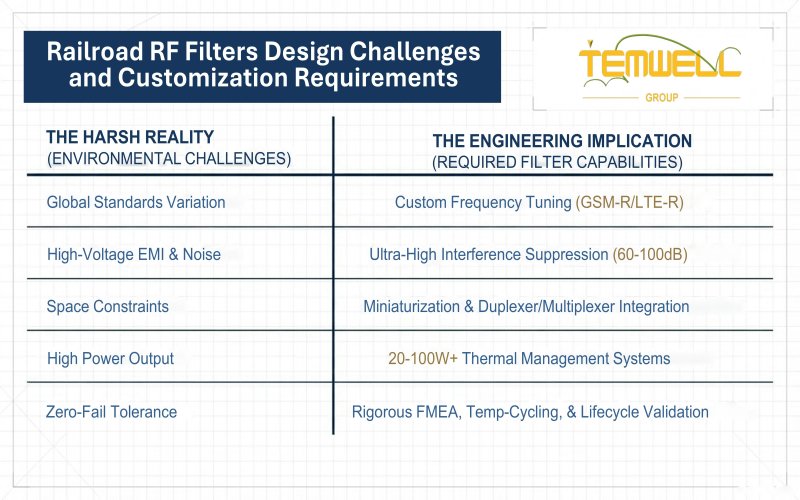
In railway communication systems, the design of RF filters faces multiple technical challenges, requiring a balance between performance, environmental adaptability, and system integration needs. Due to differences in application scenarios and international standards, standardized products often fail to fully meet actual requirements; therefore, highly customized design becomes crucial. The following section describes the main challenges and requirements.
(1) Differences in Frequency Bands and Standards Across Countries (GSM-R / LTE-R) Different countries use different frequency bands and communication standards, such as GSM-R (approximately 876–915 MHz) and LTE-R (approximately 700 MHz). RF filters need to be customized according to local regulations and spectrum configurations to ensure compliance with system compatibility and regulatory requirements.
(2) Complex Electromagnetic Environment (EMI / Noise) High-voltage electricity, transformer equipment, and metal structures exist along railway lines, which can easily generate strong electromagnetic interference. RF filters need to have high suppression (60–100 dB) and stable performance to effectively reduce noise impact and maintain communication quality.
(3) Space Constraints and Equipment Integration: Vehicle-mounted equipment and some base stations have limited space, requiring RF filters to have a miniaturized design while integrating functional modules such as duplexers and multiplexers to achieve optimal performance within a limited space.
(4) High Power and Heat Dissipation Design Requirements: Some applications need to withstand power exceeding 20–100 W. The RF filter design must balance power handling and thermal management capabilities to prevent performance degradation or component damage due to temperature rise.
(5) Customized Specifications and Rapid Development Needs: Customers often specify requirements for particular frequency bands, sizes, connector types, and performance indicators (such as low loss and high isolation). RF filter designs must be highly flexible and capable of being completed, verified, and mass-produced quickly to meet project timelines.
(6) Product Failure Assessment and Reliability Verification Requirements: Railway applications have extremely high safety requirements. RF filters must undergo complete failure mode analysis (FMEA) and life testing (such as high and low temperature cycling and vibration testing). Simultaneously, performance must be ensured to remain consistent over long-term operation and meet relevant reliability standards (such as MTBF of tens of thousands of hours or more) to reduce system risk and maintenance costs.

Solutions and Advantages from Temwell Group
Against the backdrop of increasingly stringent requirements for high reliability, high performance, and adaptability to harsh environments in railway communication systems, Temwell Group, with over 30 years of expertise in the RF and microwave fields, possesses profound technical strength and rich application experience, enabling it to provide comprehensive and highly flexible RF filter solutions. Product designs fully meet the stringent requirements of railway applications for low insertion loss (
(1) Complete Product Line
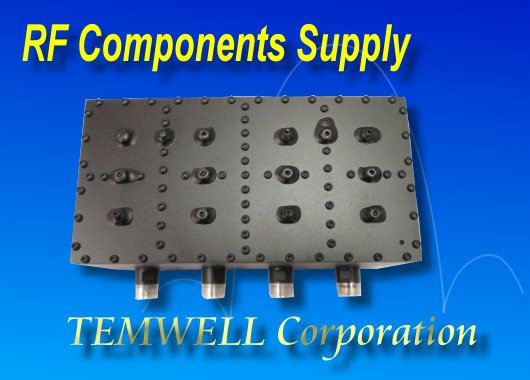
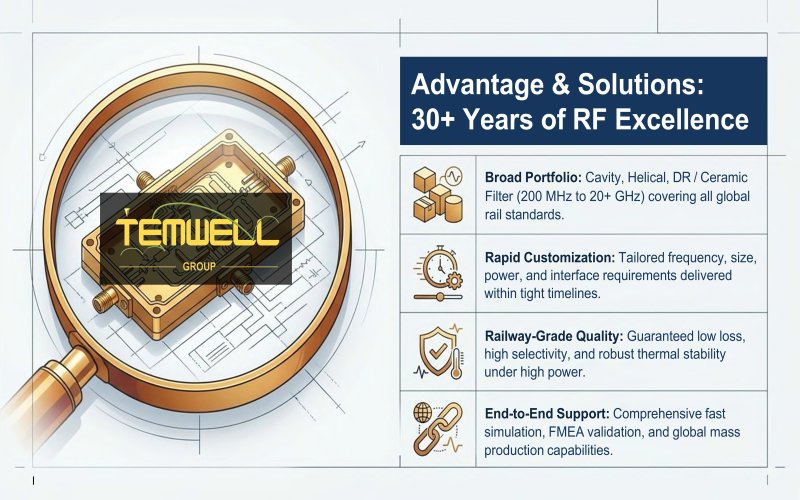
Temwell offers a diverse range of RF filter products, including cavity, helical, ceramic, and integrated components (such as duplexers and multiplexers), covering frequency bands from 200 MHz to above 20 GHz, flexibly meeting the requirements of different national standards such as GSM-R and LTE-R. Product designs balance low insertion loss and high suppression, and can provide high isolation configurations for different applications, meeting the dual space and performance requirements of vehicle-mounted and base stations.
(2) Strong Customization Capabilities
To meet the frequency band configurations and performance requirements of different railway systems (such as GSM-R and LTE-R), Temwell can provide customized designs based on customer-specified frequencies, sizes, power, and interface conditions. Whether it's high suppression (60–100 dB), low insertion loss (
(3) High Performance and Stable Quality
Temwell products emphasize low loss, high selectivity, and high isolation performance to ensure stable signal transmission. They maintain good thermal stability even in high-power applications (20–100 W and above) and can operate stably in environments ranging from -40°C to +85°C. Strict quality control and reliability verification are implemented to ensure that product performance does not degrade over long-term use.
(4) Professional R&D Team
Temwell has an experienced RF design engineering team familiar with various filter designs and railway application requirements. They can quickly perform design simulations, sample development, and performance verification, and implement Failure Mode and Effects Analysis (FMEA) and environmental testing (such as vibration and high/low temperature cycling) to ensure that products meet railway-grade reliability standards.
(5) Global Market Experience
Temwell has long served the international market and is familiar with the communication regulations and railway system requirements of various countries. They can assist customers in quickly implementing products that meet local standards. With extensive project experience and stable supply capabilities, they provide one-stop support from design to mass production, helping customers improve system performance and market competitiveness.
If you are interested in Temwell support and Service, f eel free to contact us and get free consultation services so that we can provide you with the best solution.
Subscribe to us on Facebook for the latest product news.
FAQ
RF filters are essential in railway systems because they help ensure stable and reliable wireless communication. They allow the required frequency signals to pass through while blocking unwanted interference, which is critical for train control, dispatching, onboard communication, and passenger service systems.
An RF filter helps select the correct frequency band, suppress unwanted signals, reduce noise, and improve signal clarity. It also helps isolate transmitting and receiving channels, preventing system interference and supporting the safe operation of railway communication equipment.
Railway environments often contain electromagnetic noise and interference from nearby wireless equipment or adjacent frequency bands. RF filters improve communication reliability by rejecting these unwanted signals, maintaining signal integrity, and helping communication systems perform consistently over long distances and in high-speed operating conditions.
RF filters are commonly used in onboard communication modules, trackside communication equipment, railway base stations, dispatching systems, and other wireless infrastructure. Any railway application that depends on stable RF signal transmission can benefit from high-performance filtering solutions.
RF filters help protect sensitive receivers and other key components by suppressing high-power unwanted signals, surges, and out-of-band interference. This added protection can improve system safety, reduce the risk of equipment damage, and extend the service life of communication devices.
Yes. RF filters are designed to isolate specific frequency ranges and reject adjacent or unwanted signals. This helps prevent interference between different communication systems operating in the same railway environment, allowing multiple systems to function smoothly and independently.
Important considerations include operating frequency, insertion loss, rejection performance, isolation, power handling, and environmental durability. Because railway systems often operate in demanding conditions, the RF filter must deliver both strong electrical performance and long-term reliability.
Yes. RF filters play an important role in GSM-R, LTE-R, and other railway wireless communication systems. They help ensure accurate frequency selection, reduce interference, and maintain stable communication performance, which is essential for safe and efficient railway operations.