
Why are RF filters important in Radar systems?
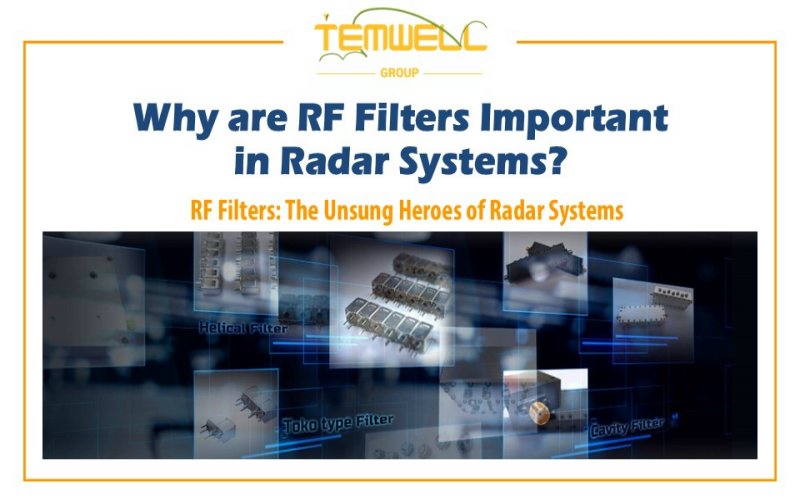
Why Radar system needs RF filter?
The core task of a radar system is to transmit radio frequency signals in complex electromagnetic environments and accurately determine the target's distance, speed, and position from extremely weak echoes. However, in reality, spectrum resources are highly congested, and various communication systems, other radar devices, and noise coexist, forcing the radar receiver to precisely switch between "high-power transmission" and "ultra-low signal reception." This is precisely why RF filters are indispensable.
From a system perspective, the RF filter is the first line of defense for the radiator's spectrum. It is responsible for selecting the target operating frequency band, filtering out unnecessary signals, and preventing adjacent and co-channel interference from entering the receiving link. At the receiver, the RF filter effectively suppresses strong interference and noise, protecting the back-end LNA and mixer from blockage or saturation, ensuring that weak echoes can still be correctly amplified and resolved. Furthermore, in architectures where the transmit and receive antennas share a common antenna, the RF filter plays a crucial role in isolating the TX and RX signals, determining whether the system can operate stably.
In summary, while RF filters do not directly generate radar signals, they profoundly impact overall performance. Insertion loss affects detection range, bandwidth and group delay influence resolution and accuracy, and suppression capability determines interference resistance and the risk of false alarms. Without a well-designed RF filter, even a radar system equipped with advanced algorithms and high-efficiency antennas will struggle to reach its full potential. The RF filter is indeed the unassuming yet crucial cornerstone of a radar system.
Where is RF Filter in Radar system?
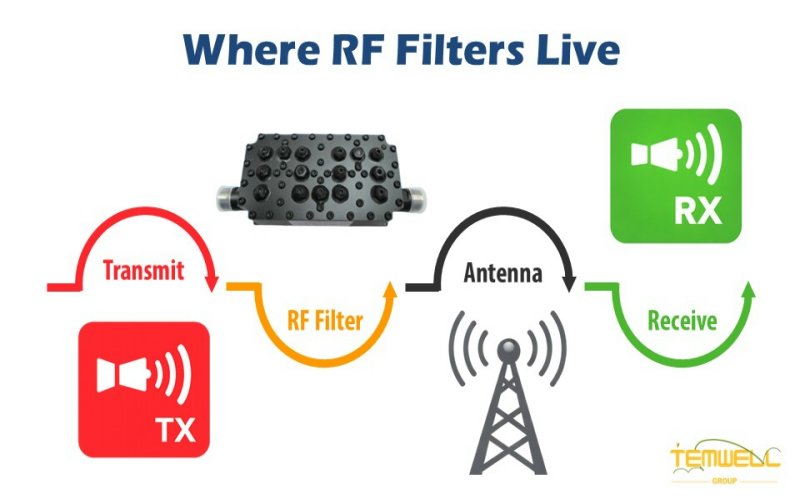
The basic architecture of a radar system can be divided into the transmitter (TX), receiver (RX), antenna, and RF front-end. In this architecture, the RF filter is not a single component, but is distributed in multiple key locations throughout the entire signal path, playing an irreplaceable role.
At the transmitting end, the RF filter is typically located after the signal source or power amplifier (PA) to limit the output spectrum, suppress harmonics and spurious signals, and ensure that the transmitted signal complies with system frequency band and regulatory requirements. The filtering quality at this stage directly affects the purity of the transmitted signal and the degree of interference to the outside world.
At the receiver, RF filters are mostly positioned before the antenna and low-noise amplifier (LNA), serving as the first line of defense in the receiver link. Because the echo signal is extremely weak, any strong interference from the outside can cause receiver saturation or distortion. Therefore, the main task of the receiver filter is to retain the target frequency band signal while minimizing unnecessary spectral energy.
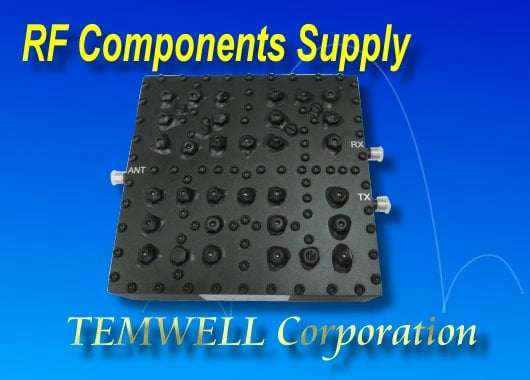
In most radiar systems, the transmitter and receiver share the same antenna. In this case, an RF filter exists at the antenna end in the form of a duplexer or a filtering network to isolate the TX and RX signals, preventing high-power transmitted signals from directly entering the receiver path. The filtering design at this location often determines the stability and dynamic range of the entire radar system.
Overall, the RF filter is deeply embedded in every key node of the Radar system and is an indispensable core component connecting the TX, RX and the antenna.
The Three Core Roles of RF Filters in Radar
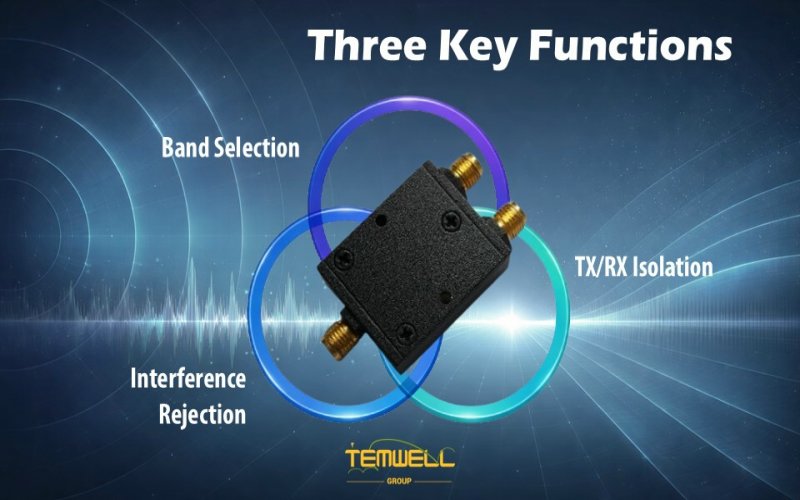
In a radar system, the RF filter is not an auxiliary component, but a key element that directly affects the system's stable operation and accurate interpretation. Its functions can be summarized into three core tasks: frequency band selection, interference suppression, and transmission and reception isolation.
First, band selection. RF filter is responsible for precisely defining the operating frequency band of the radiator, allowing only the target frequency to pass and suppressing unnecessary adjacent channels and spurious signals. In highly congested spectrum environments, good band selection capabilities ensure that the radiator is not affected by communication systems or other radiators, and also determine the system's available bandwidth and resolution performance.
Second, interference suppression and receiver protection. Radar echo signals are extremely weak, and the receiver is extremely sensitive to strong interference. RF filters are typically placed before the antenna and low-noise amplifier to reduce blocking effects and noise energy, prevent receiver saturation or distortion, and ensure that weak target signals can still be correctly amplified and processed.
Third, transmit/receive isolation (TX/RX isolation). In a radar architecture where transmit and receive share the same antenna, RF filter exists in the form of a duplexer or filter network to provide sufficient isolation, preventing high-power transmit signals from directly entering the receive path. This function directly affects the dynamic range of the radar and the overall system stability.
These three roles together constitute the irreplaceable value of the RF Filter in the Radar system.
Radar Requirements toward RF Filters
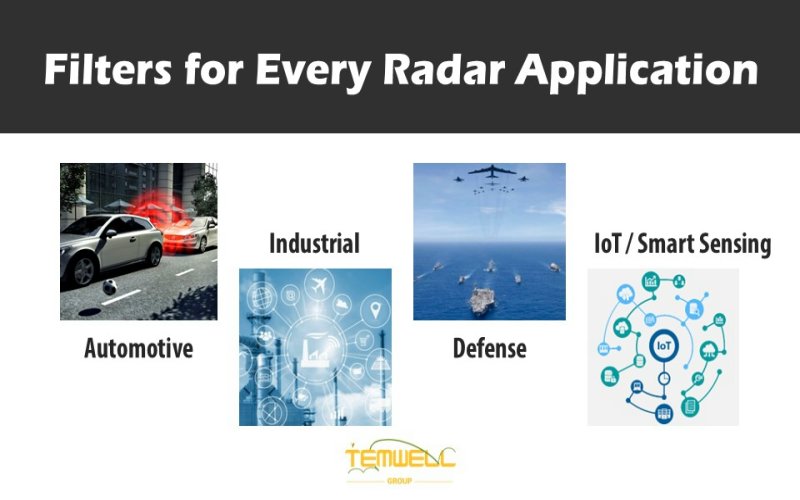
With the widespread application of RF technology in automotive, industrial, defense, and sensing fields, the requirements to RF filters vary significantly across different application scenarios. These differences stem from variations in operating frequency bands, system architectures, environmental conditions, and cost constraints, necessitating a high degree of customization in RF filter design.
In automotive radar systems, miniaturization, low insertion loss, and temperature stability are emphasized. Due to the drastic changes in the vehicle operating environment, RF filter must maintain frequency accuracy over a wide temperature range to ensure the reliability of measured distance and speed.
Industrial radar is often used for storage status monitoring, distance or speed detection. The working environment may contain a lot of electromagnetic interference, so the selectivity and suppression capability of the RF filter are required to avoid external noise affecting the measurement results.
In military and defense radar applications, RF filters need to withstand high power output and have extremely high reliability and isolation performance, while also emphasizing long-term stability and resistance to environmental stress to ensure that the system can still operate normally under harsh conditions.
As for indoor sensing and IoT Radar, more emphasis is placed on size, cost, and process consistency. RF Filters need to balance basic performance within a limited space and support large-scale deployment requirements.
Overall, the requirements of different Radar applications for RF filters reflect the fundamental differences in system objectives and usage scenarios.
How RF filter specifications affect radar performance
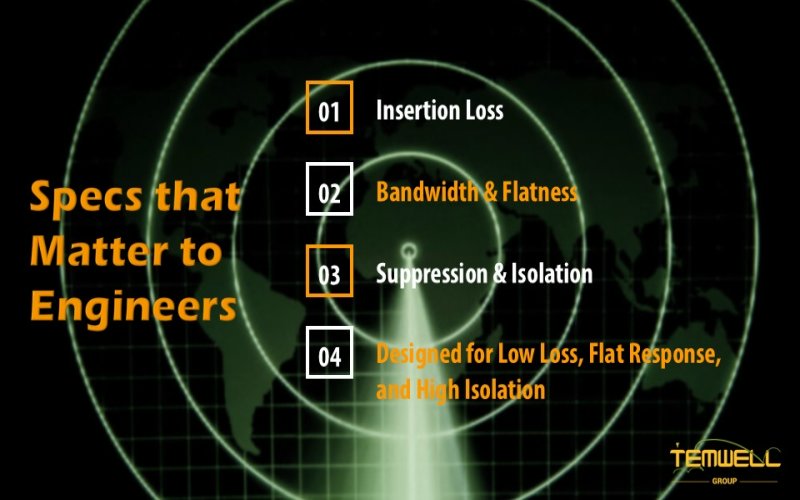
Radar systems place far higher demands on RF filters than typical communication applications, as they must simultaneously handle high-power transmitted signals and extremely weak echo signals, and operate stably for extended periods in complex and congested electromagnetic environments. In radar systems, the electrical specifications of the RF filter are not independent but are highly interconnected with overall performance. Different filter parameters directly affect the radar's detection range, resolution, stability, and false alarm risk, making them critical factors that cannot be ignored in system design.
First, Insertion Loss directly affects the effective detection range of the system. Insertion Loss at the transmitting end reduces the actual output power, while Insertion Loss at the receiving end weakens the echo signal strength, lowers the signal-to-noise ratio, and thus shortens the maximum detectable range of the radar.
Secondly, Bandwidth and passband flatness affect range and velocity resolution. Wider Bandwidth improves resolution, but excessive passband fluctuations can lead to signal amplitude distortion, affecting the accuracy of target identification. Meanwhile, group delay and phase characteristics are particularly important for radars using frequency modulation or pulse techniques; uneven group delay can cause echo waveform distortion, reducing ranging and velocity measurement accuracy.
Furthermore, suppression capability and isolation determine the interference immunity of a radiator. Good adjacent channel suppression can reduce the impact of external noise and other systems, while sufficient TX/RX isolation can prevent high-power transmit signals from entering the receive link, ensuring stable operation of the system within the dynamic range.
In summary, every specification of RF filter is a crucial foundation for the radar to see far, see accurately, and operate stably.
Commonly RF Filter Types in Radar system
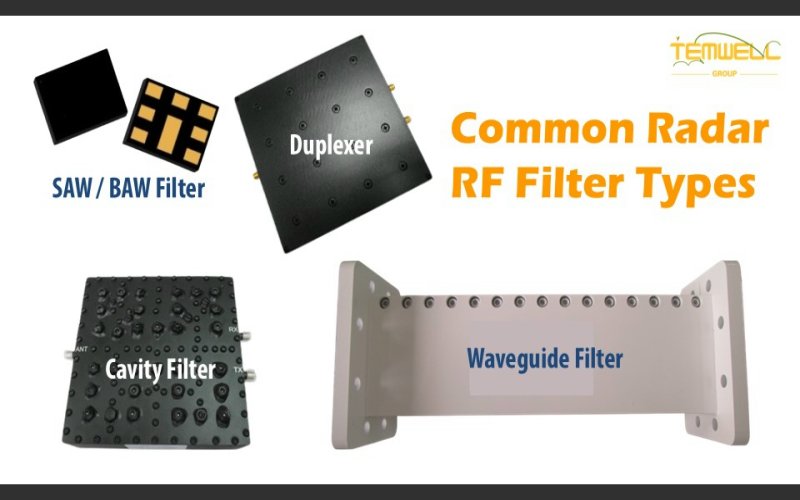
In a radian system, RF filters are implemented using different forms and technologies depending on the operating frequency band, system architecture, and performance requirements. Although these filters are similar in principle, they play different roles in practical applications.
The most common type is RF Bandpass filter, which is mainly used to limit the operating frequency band of the radiator, allowing only the target frequency to pass through and suppressing adjacent channels and spurious signals. These kinds of RF filter is widely used in both the transmitting and receiving ends and are fundamental components of the radiator's RF front-end.
In architectures where both transmit and receive share an antenna, a duplexer or a filtering network composed of multiple RF filters is often used to isolate the TX and RX signals. Its core function is to prevent high-power transmit signals from entering the receive path, ensuring stable system operation even when transmitting and receiving simultaneously.
For high-frequency or millimeter-wave radar, high-Q resonant filters or waveguide filters are commonly used. These filters offer low loss and high selectivity, making them suitable for high-power and high-resolution applications, but they are relatively large and expensive.
As systems become smaller, some radiators are beginning to adopt on-chip or in-package filters to meet size and mass production requirements. The choice of different RF filter types ultimately depends on the performance goals and application scenarios of the radiator system.

Customization Filter Services from Temwell
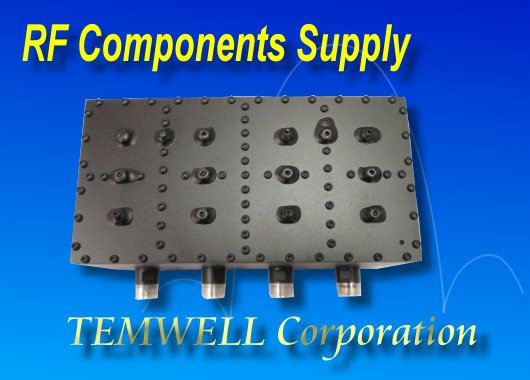
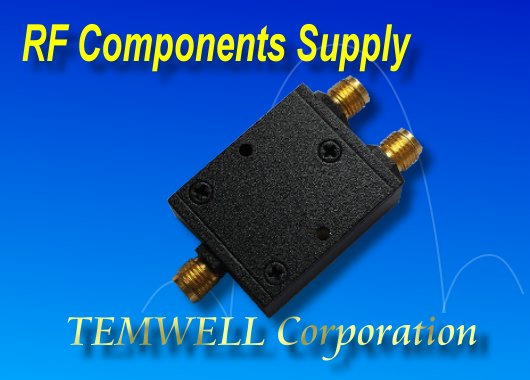
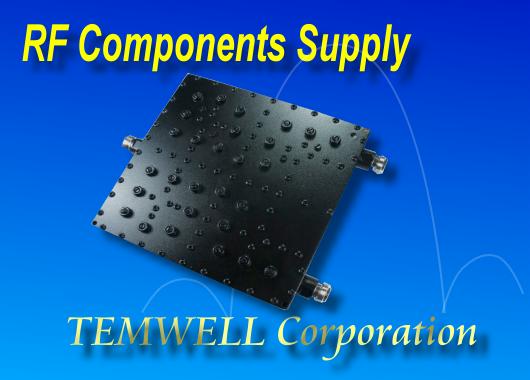
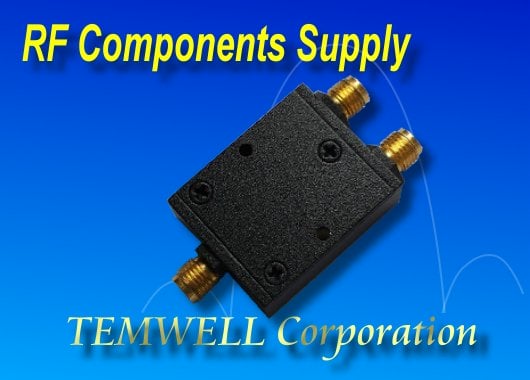
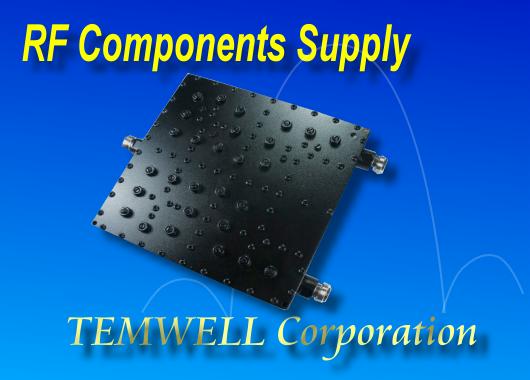
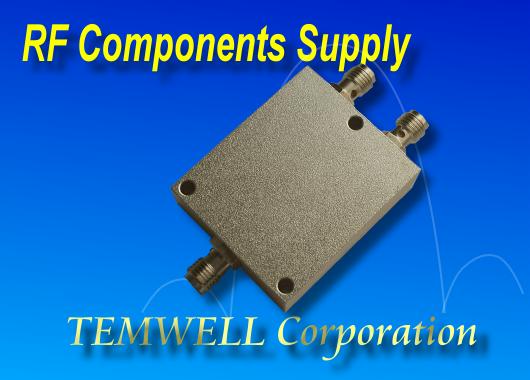
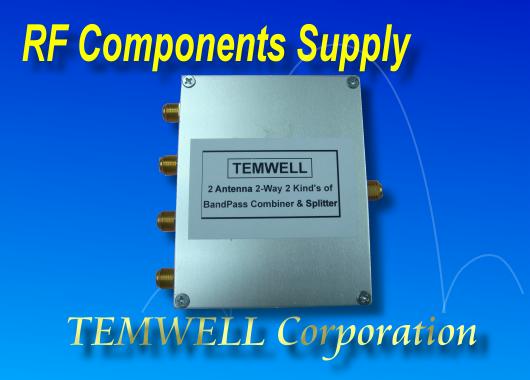
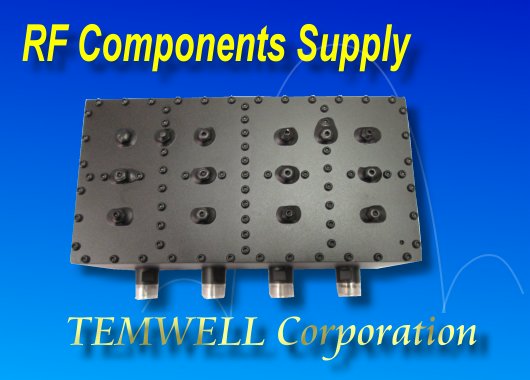
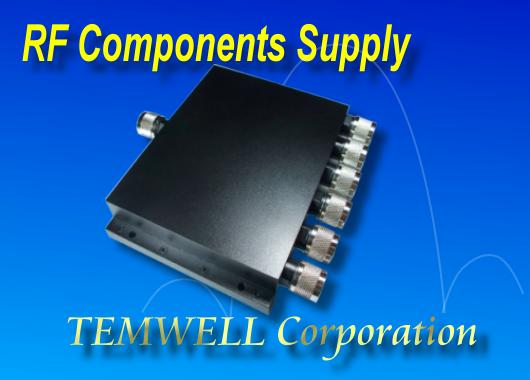
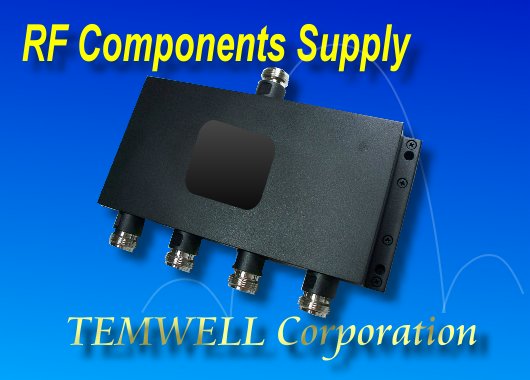
Temwell Group has a long history of expertise in the RF component field and can provide a variety of customized RF filter and duplexer solutions to meet different application needs, helping customers achieve the best performance balance in complex RF systems.
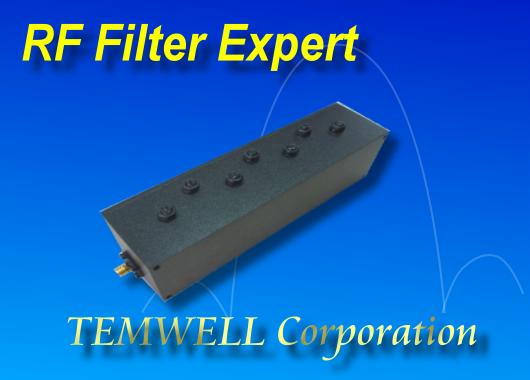
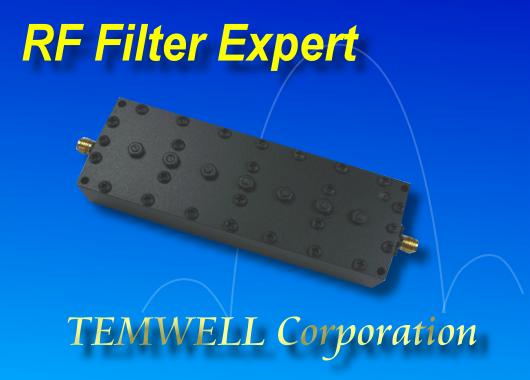
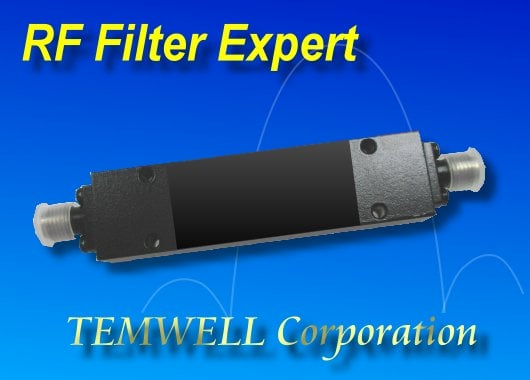
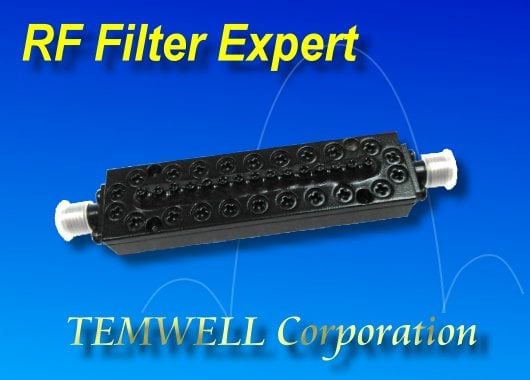
In terms of filter products, Temwell can design customized bandpass filters based on system frequency band, bandwidth requirements, and suppression targets, covering various application conditions from low to high frequencies and from narrow to wide frequencies. Our engineering team can optimize key specifications such as Insertion loss, Selectivity, Group delay, and temperature stability, so that the RF filter can better meet the actual system requirements, rather than just conforming to the datasheet values.
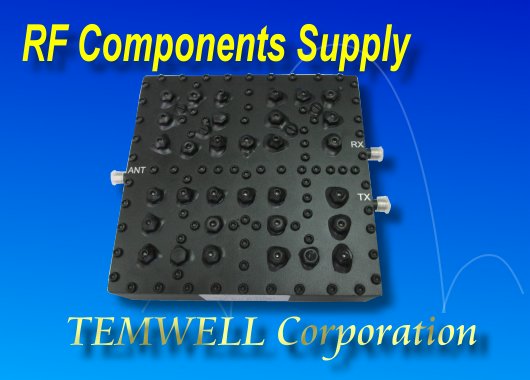
In the duplexer field, Temwell offers integrated or modular designs to help customers achieve stable TX/RX isolation in shared antenna architectures, depending on transmit and receive band configurations, isolation requirements, and power conditions. This type of customization is particularly suitable for radar, wireless communications, and high dynamic range systems.
When standard products cannot fully meet application requirements, Temwell's engineering team can start from the system end, work with customers to evaluate architectural limitations and performance goals, and propose matching filter or duplexer design solutions to shorten development time and reduce overall integration risks, becoming a reliable technology partner in customers' RF design.
If you are interested in Temwell support and Service, feel free to contact us and get free consultation services so that we can provide you with the best solution.
Subscribe to us on Facebook for the latest product news.