
How to design in Ceramic Filter
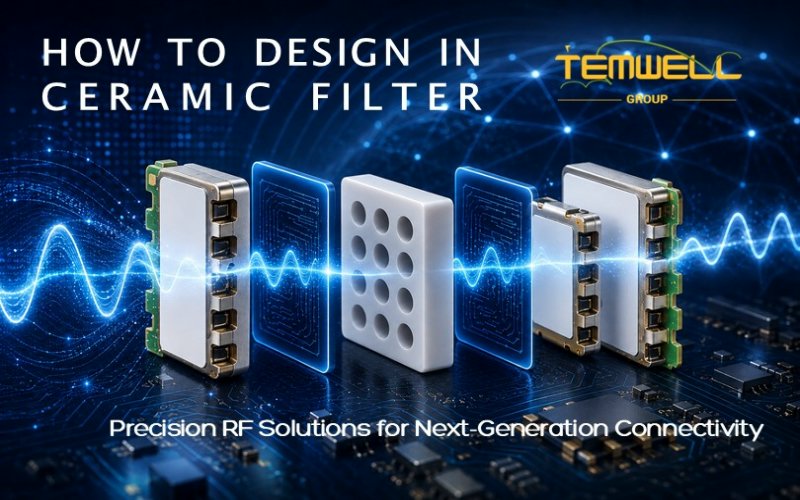
Ceramic filters are radio frequency (RF) filtering components designed using the principle of dielectric resonance. They are characterized by their small size, cost-effectiveness, and excellent stability, making them particularly suitable for mid- to high-frequency wireless communication applications. Compared to cavity filters, ceramic filters offer advantages in size and integration, making them suitable for space-constrained devices requiring mass production, such as wireless communication modules, IoT devices, and consumer electronics. Their good selectivity and moderate insertion loss effectively filter unwanted frequency band signals, ensuring stable communication quality. Furthermore, ceramic filters are widely used in automotive electronics and industrial communication systems, providing reliable and competitive filtering solutions while balancing performance and cost.
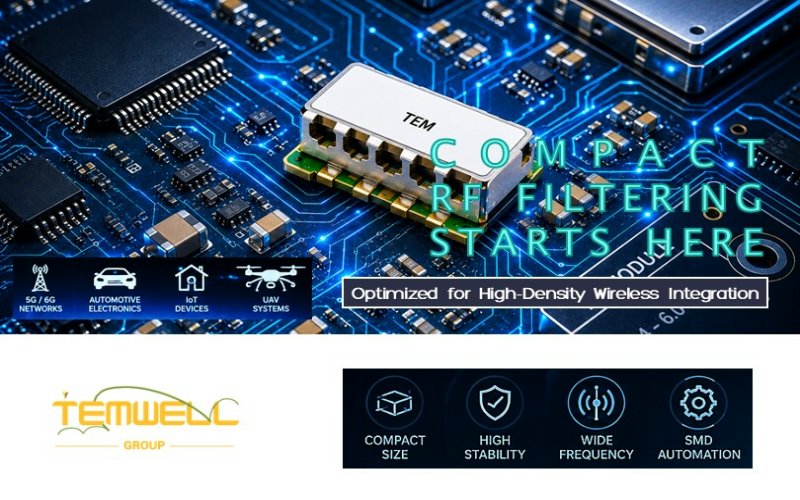
Core Technical Characteristics of Ceramic Filter
1. Miniaturization and High Integration Advantages (Small Size)
Ceramic filters are designed with high dielectric constant materials, significantly reducing component size and making them suitable for high-density circuits and modular applications. Compared to larger cavity filters and medium-sized helical filters, ceramic filters offer significant advantages in miniaturization and high integration, making them particularly suitable for IoT modules, automotive electronics, and various embedded systems. They effectively improve design flexibility and reduce system space constraints.
2. Low Development Cost and High Efficiency
Ceramic filters offer significant cost advantages in development and mass production. Compared to SAW filters, ceramic filters offer greater design flexibility, shorter development cycles, and do not require costly dedicated processes and molds. While SAW filters are smaller and suitable for high-frequency applications, they are more limited in terms of customization and cost control. Ceramic filters, on the other hand, provide a more flexible and cost-effective solution for medium-performance requirements.
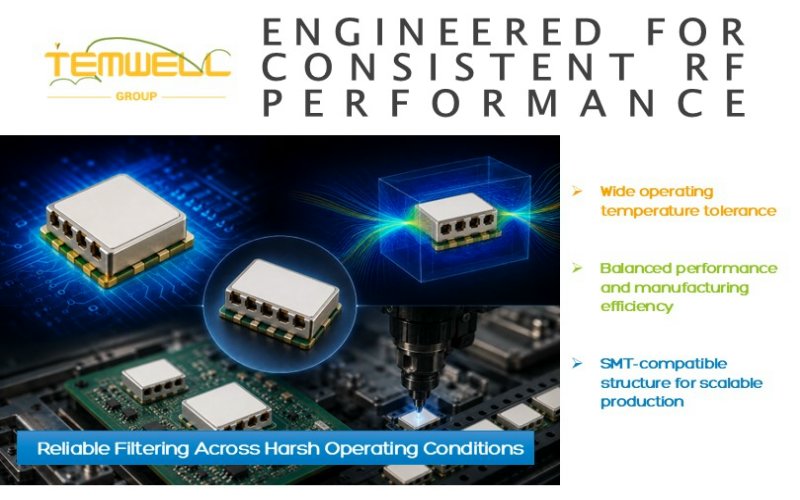
3. Stability under Temperature Influences (-50°C ~ +125°C)
Ceramic Filter exhibits excellent temperature stability, maintaining a stable center frequency and frequency response even under drastic temperature variations ranging from -50°C to +125°C. Its material properties result in low sensitivity to temperature changes and good resistance to temperature drift, ensuring stable operation of the system in alternating high and low temperature environments or harsh conditions. This makes it particularly suitable for automotive and industrial applications.
4. Excellent Performance in Mid-to-High Frequency Bands (300MHz–6GHz)
Ceramic filters exhibit stable and reliable performance in the 300MHz to 6GHz frequency band, providing good frequency selectivity and moderate insertion loss, meeting the needs of most wireless communication applications. Their mature design in the mid-to-high frequency band allows for flexible adaptation to different frequency and bandwidth specifications, making them widely used in Wi-Fi, Bluetooth, IoT, and various communication modules. They offer stable and efficient filtering solutions while balancing performance and cost.
5. Suitable for Automated Production (SMD Type)
Ceramic filters are primarily available in SMD (Surface Mount Device) packages, perfectly suited to the automated production needs of modern electronics manufacturing. Their standardized dimensions and package design are suitable for SMT (Surface Mount Technology) processes, significantly improving production efficiency and yield while reducing labor costs and assembly errors. Compared to filter types requiring manual adjustment, ceramic filters are better suited for large-scale mass production applications, particularly high-volume products such as communication modules, automotive electronics, and industrial equipment.
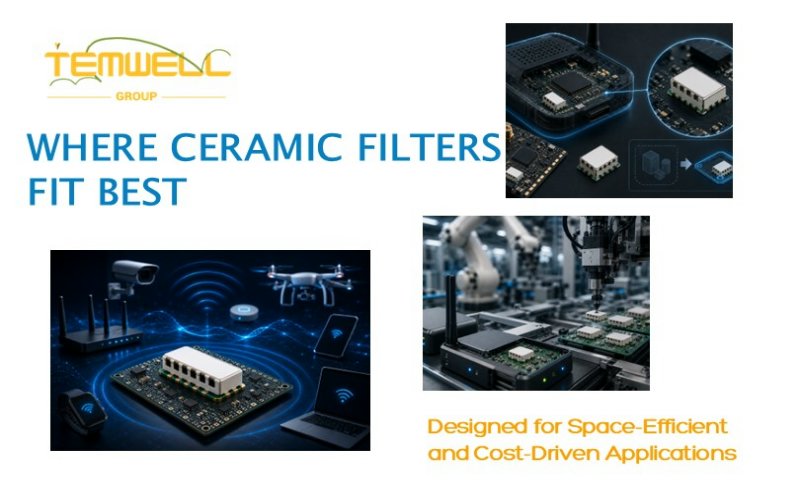
Suitable Scenarios for Using Ceramic Filters
1. Space Constraints (Miniaturization Required)
In space-constrained applications such as IoT modules, automotive electronics, or embedded systems, ceramic filters are particularly suitable due to their small size and light weight. Their high integration effectively reduces PCB footprint, allowing for greater system design flexibility. Compared to larger cavity filters or helical filters, ceramic filters provide stable filtering performance within limited space, making them an ideal choice for miniaturized product designs.
2. SMD Automated Production Needs
When products require mass production and rely on SMT processes, Ceramic Filters, primarily in SMD packaging, fully meet the requirements of automated placement. Their standardized dimensions and high consistency help improve production efficiency and yield, while reducing labor costs and manufacturing errors. They are particularly suitable for applications requiring high throughput and stable quality, such as communication modules, industrial equipment, and automotive electronics.
3. Customization Needs in Mid-to-High Frequency Bands (3G–6G)
In mid-to-high frequency applications from 3GHz to 6GHz, such as Wi-Fi, Bluetooth, or various wireless modules, Ceramic Filters offer stable frequency response and good selectivity. Their design is flexible and can be adjusted to meet different frequency and bandwidth requirements, satisfying diverse application scenarios. Compared to higher-cost SAW or BAW solutions, Ceramic Filters offer a good performance-to-cost balance in this frequency band.
4. Temperature Resistance is Required
In applications requiring resistance to temperature variations, such as automotive or industrial equipment, ceramic filters offer excellent temperature stability. Their material properties allow them to maintain a stable frequency response under varying temperatures, reducing the impact of temperature drift. Even in environments ranging from -50°C to +125°C, they maintain reliable operation, ensuring system stability and long service life.
5. Cost-Sensitive Applications
When applications are cost-sensitive and require a balance between performance and mass production feasibility, Ceramic Filters are the ideal choice. Their manufacturing process is mature, development costs are low, and design flexibility is high, allowing for rapid adaptation to diverse application needs. Compared to the limitations of SAW Filters in customization and mold making, Ceramic Filters offer a more flexible and cost-effective solution, making them particularly suitable for large-scale commercial products.

Main Application Areas and Scenarios
1. Wireless Modules
Ceramic filters are widely used in IoT modules (Wi-Fi/Sub-6GHz), Bluetooth devices, and short-range communication devices. They offer stable performance in mid-to-high frequency bands and can be integrated into modules via SMD packaging, improving overall design efficiency and mass production capabilities. They are an indispensable key component in wireless connectivity products.
2. Smart Meters and AMR Systems
Smart meters and automatic meter reading systems require long-distance data transmission via Sub-GHz or low-to-mid-frequency wireless communication, demanding stable operation and low power consumption over extended periods. Ceramic filters offer stable frequency response and strong anti-interference capabilities, ensuring accurate data transmission. Their miniaturization and SMD packaging facilitate integration into modules and support large-scale automated production, while also providing excellent cost-effectiveness, making them ideal for large-scale infrastructure applications.
3. IoT Communication Module (Sub-6GHz)
IoT devices require large-scale deployment and are cost-sensitive, while also demanding stable communication. Ceramic filters offer excellent mid-to-high frequency performance and design flexibility to meet the needs of different frequency bands. Their SMD packaging allows for automated production and provides stable filtering within limited space, making them one of the best choices for IoT modules, balancing cost, size, and performance.
4. Automotive Electronics
Ceramic filters are used in vehicle-to-everything (V2X) communication modules, GPS/GNSS receiving systems, and automotive wireless control systems. They possess excellent temperature stability and environmental tolerance, allowing for stable operation for extended periods under harsh automotive conditions, ensuring the reliability and accuracy of communication and positioning systems.
5. Industrial RF Module:
Industrial equipment requires stable operation over extended periods and must be interference-resistant. Ceramic filters offer stable frequency response and reliable filtering performance at a cost-effectiveness, making them suitable for large-scale deployment. Their environmental resistance also makes them suitable for various industrial applications.
6. UAV Communication Systems
UAV applications require stable and low-latency signal transmission to ensure accurate flight control and image transmission. Ceramic filters offer excellent frequency selectivity and interference immunity, effectively reducing the impact of external signals and ensuring stable transmission of control commands. Their miniaturization and lightweight characteristics make them particularly suitable for size- and weight-sensitive UAV designs, while also offering cost advantages, making them widely used in consumer and industrial UAV communication systems.
7. Smart Home Security Systems
Smart access control, smart locks, wireless doorbells, and home security devices require stable communication via Sub-GHz or 2.4GHz frequency bands to ensure accurate real-time control and signal feedback. Ceramic filters offer stable frequency selectivity and excellent anti-interference capabilities, preventing external signal interference from affecting system decisions. Their miniaturized and SMD packaged design facilitates integration into various compact devices and supports automated mass production, balancing cost and performance, making them particularly suitable for large-scale smart home deployments.
8. Wireless Control & Telemetry Equipment
In remote control and monitoring systems, ceramic filters provide stable frequency filtering capabilities, reducing the risk of interference. Their excellent stability and cost advantages make them widely used in industrial control and long-distance data transmission systems.
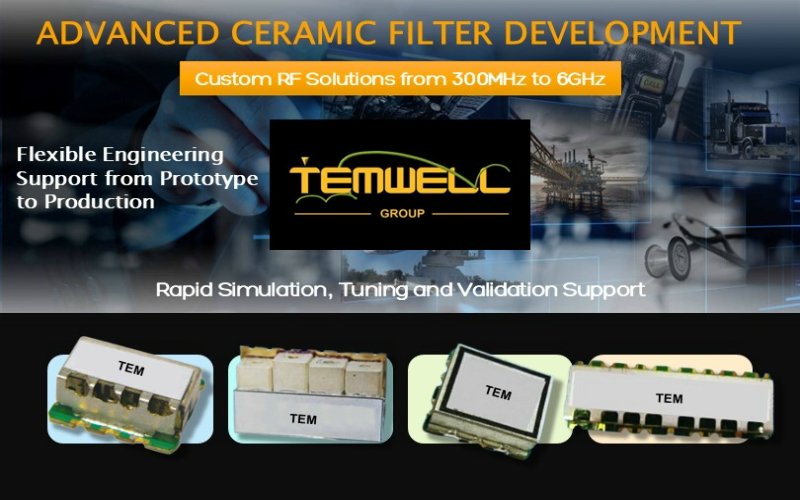
Customized Ceramic Filters provided by Temwell Group
Temwell boasts an experienced and technically strong R&D team with a long-standing focus on RF filter technology, particularly in the design and application of ceramic filters, where we have accumulated extensive practical experience. Our team is familiar with various ceramic filter architectures and can customize designs based on different application requirements, from frequency range and bandwidth configuration to packaging, covering a wide range of single-unit filters and module integration applications. Through electromagnetic simulation, material selection, and structural optimization, Temwell fully leverages the core advantages of ceramic filters, including miniaturization, high integration, stable frequency characteristics, and excellent cost-effectiveness.
In terms of technical capabilities, Temwell's R&D team can perform precise designs for mid-to-high frequency bands from 300MHz to 6GHz, ensuring stable performance under various application conditions. Simultaneously, for SMD packaging requirements, our team can optimize product structure to conform to automated production processes, improving yield and consistency. Furthermore, regarding temperature stability and environmental adaptability, adjustments to materials and design ensure reliable operation even under harsh conditions.
Temwell's R&D advantage lies not only in the technological depth but also in the integrated capabilities across the entire development process. From requirements analysis, design and development, sample verification to mass production implementation, it provides rapid and comprehensive support, helping customers shorten development timelines and reduce costs. With the strong R&D capabilities and flexible customization, Temwell fully translates the features of Ceramic Filters into practical application advantages, finding wide applications in consumer electronics, wireless communication modules, automotive electronics, and industrial equipment, comprehensively meeting the needs of various application scenarios suitable for Ceramic Filters.
If you are interested in Temwell support and Service, f eel free to contact us and get free consultation services so that we can provide you with the best solution.
Subscribe to us on Facebook for the latest product news.
Yes. RF filters play an important role in GSM-R, LTE-R, and other railway wireless communication systems. They help ensure accurate frequency selection, reduce interference, and maintain stable communication performance, which is essential for safe and efficient railway operations.